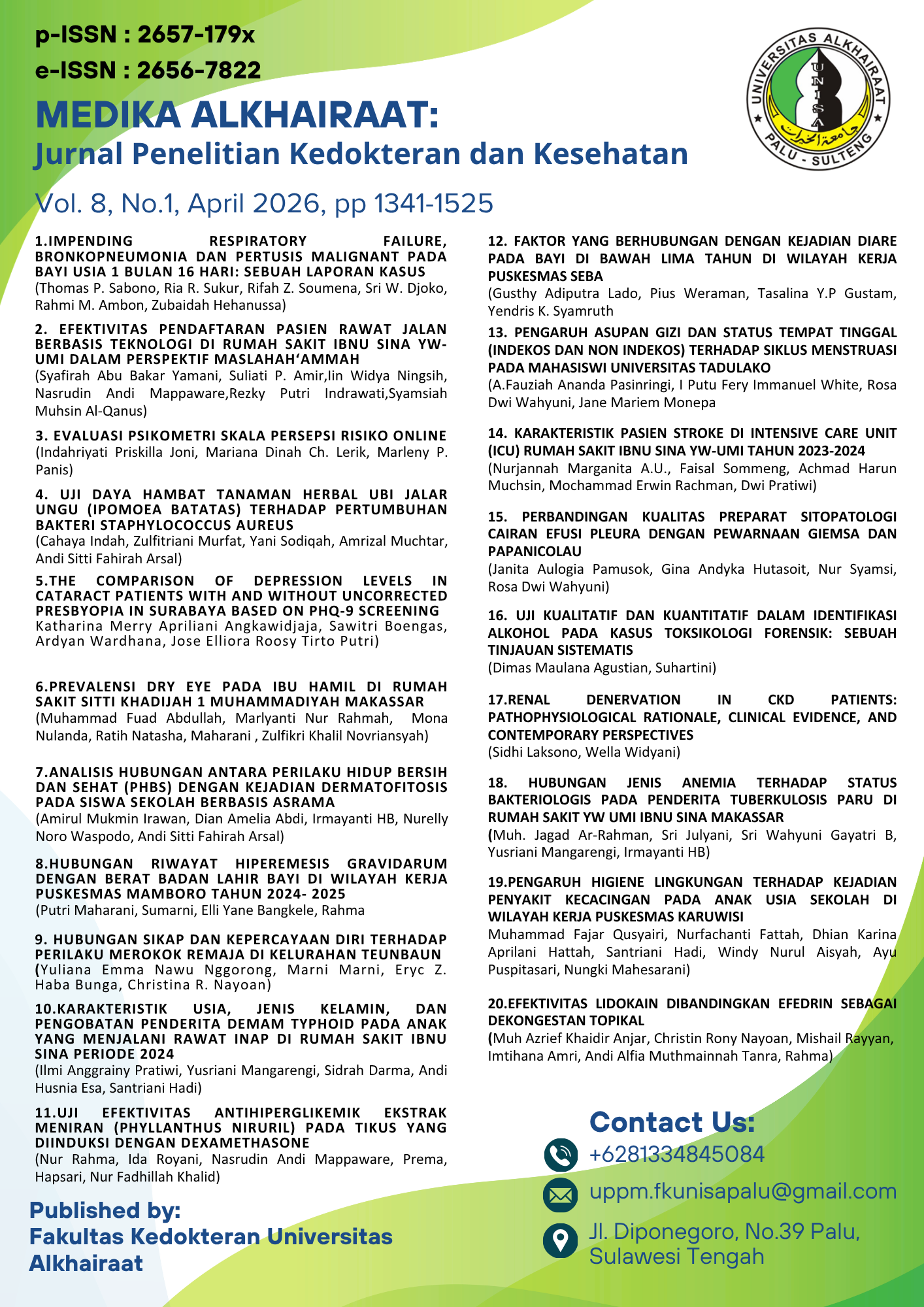
THE COMPARISON OF DEPRESSION LEVELS IN CATARACT PATIENTS WITH AND WITHOUT UNCORRECTED PRESBYOPIA IN SURABAYA BASED ON PHQ-9 SCREENING
THE COMPARISON OF DEPRESSION LEVELS IN CATARACT PATIENTS IN SURABAYA
Abstract
ABSTRAK
Katarak merupakan penyebab utama gangguan penglihatan pada populasi lansia dengan prevalensi yang tinggi di Indonesia, terutama di Jawa Timur. Selain katarak, pada lansia juga sering ditemukan penurunan daya akomodasi yang mengikuti yaitu presbyopia. Kedua hal tersebut diduga dapat meningkatkan risiko kejadian depresi atau gangguan suasana hati yang berdampak negatif pada kualitas hidup seseorang. Penelitian ini bertujuan untuk membandingkan tingkat depresi pada penderita katarak dengan dan tanpa presbyopia yang belum terkoreksi di Surabaya berdasarkan screening PHQ-9. Penelitian ini menggunakan rancangan studi observasional analitik dengan desain cross-sectional menggunakan data sekunder dari kegiatan “Bakti Sosial Pembagian Satu Juta Kacamata.” Data pada penelitian ini terdiri dari 107 data responden penderita katarak yang diperoleh dengan total population sampling dan metode purposive sampling. Data kemudian terbagi ke dalam dua kelompok berdasarkan adanya presbyopia yang belum terkoreksi dan diolah untuk membandingkan derajat depresi yang dialami berdasarkan screening PHQ-9. Hasil penelitian menunjukkan bahwa 65% penderita mengalami depresi. Namun, tidak terdapat perbedaan tingkat depresi yang signifikan antara kelompok katarak dengan presbyopia yang belum terkoreksi dan tanpa presbyopia yang belum terkoreksi berdasarkan skor screening PHQ-9 (p=0.76). Analisis pengaruh faktor risiko seperti usia, jenis kelamin, riwayat penyakit kronis, riwayat penggunaan NAPZA, alkohol, dan rokok juga tidak menunjukkan hubungan yang signifikan dengan kejadian depresi.
ABSTRACT
Background: Cataracts are a leading cause of visual impairment in the elderly, with high prevalence in Indonesia, particularly East Java. Presbyopia, a common accommodation disorder in older adults, often accompanies cataracts and may increase depression risk, negatively impacting quality of life. Methods: This analytical observational cross-sectional study used secondary data from the “One Million Glasses Community Service” event in Surabaya on September 24, 2023. A total of 107 cataract patients were sampled using total population and purposive sampling methods, divided into groups with and without uncorrected presbyopia. Depression levels were assessed using the Patient Health Questionnaire-9 (PHQ-9). Data were analyzed using the Mann-Whitney test for PHQ-9 scores and chi-square test for proportions, with a significance threshold of p ≤ 0.05. Results: Overall, 65% of patients experienced depression (PHQ-9 score ≥ 5). No significant difference in depression levels was found between cataract patients with uncorrected presbyopia (median PHQ-9 score: 5, range: 0–9) and without uncorrected presbyopia (median: 5, range: 0–9; p = 0.764). Risk factors (age, gender, chronic diseases, substance use, alcohol, smoking) showed no significant association with depression (p ≥ 0.05). Conclusion: Depression levels were similar in cataract patients with and without uncorrected presbyopia, with both groups exhibiting mild depression. Routine mental health screening is recommended in cataract management programs
Downloads
References
Bourne RRA, Steinmetz JD, Saylan M, et al. Causes of blindness and vision impairment in 2020 and trends over 30 years, and prevalence of avoidable blindness in relation to VISION 2020: The Right to Sight: An analysis for the Global Burden of Disease Study. The Lancet Global Health. 2021;9(2):e144-e160. doi:10.1016/S2214-109X(20)30489-7
Rif’Ati L, Halim A, Lestari YD, Moeloek NF, Limburg H. Blindness and Visual Impairment Situation in Indonesia Based on Rapid Assessment of Avoidable Blindness Surveys in 15 Provinces. Ophthalmic Epidemiology. 2021;28(5):408-419. doi:10.1080/09286586.2020.1853178
Kemenkes RI. Riset Kesehatan Dasar (Riskesdas) Dalam Angka 2013.; 2013.
Majumdar S TK. Hyperopia. Treasure Island (FL): StatPearls Publishing.
Du Z, Zhang X, Hu Y, et al. Association of hyperopia with incident clinically significant depression: epidemiological and genetic evidence in the middle-aged and older population. British Journal of Ophthalmology. 2023;107(12):1907-1913. doi:10.1136/bjo-2022-321876
Chen PW, Liu PPS, Lin SM, Wang JH, Huang HK, Loh CH. Cataract and the increased risk of depression in general population: a 16-year nationwide population-based longitudinal study. Scientific Reports. 2020;10(1):1-8. doi:10.1038/s41598-020-70285-7
World Health Organization. Depression.
Zheng Y, Wu X, Lin X, Lin H. The Prevalence of Depression and Depressive Symptoms among Eye Disease Patients: A Systematic Review and Meta-analysis. Scientific reports. 2017;7:46453. doi:10.1038/srep46453
Suryadi A. HR Education Investment and Development: Issues, Theories and Applications for Indonesia’s Educational Development and Human Resources.; 2012.
Li HM, Yan WJ, Wu YW, Huang ZY. Cognitive control in honesty and dishonesty under different conflict scenarios: insights from reaction time. Frontiers in Psychology. 2024;15(March):1-5. doi:10.3389/fpsyg.2024.1271916
Sumomba Y, Ernawati T, Sustini F. Level Knowledge Of Cataract, Education, And Sosioeconomic Status With Preoperative Visual Acuity In Patients With Senile Cataract In Phc Hospital Of Surabaya. Journal of Widya Medika Junior. 2019;1(3):165-173. doi:10.33508/jwmj.v1i3.2099
Wijayanti LA, Mainassy MC, Aryadi A, Pannyiwi R, Said A, Harlina H. Analysis of Age and Gender Factors on the Incidence Rate of Cataracts in the Ophthalmology Clinic. International Journal of Health Sciences. 2023;1(3):258-265. doi:10.59585/ijhs.v1i3.99
Zetterberg M, Celojevic D. Gender and cataract-The role of estrogen. Current Eye Research. 2015;40(2):176-190. doi:10.3109/02713683.2014.898774
Choirunisa L, Firdausi AA, Tri H, Hasan C. Risk Factor Analysis of Cataracts in Primary Health. 2024;6(2):72-79.
Kang M-J, Do K-Y, Park N, Kang M-W, Jeong KS. The Risk of Major Depressive Disorder Due to Cataracts among the Korean Elderly Population: Results from the Korea National Health and Nutrition Examination Survey (KNHANES) in 2016 and 2018. International journal of environmental research and public health. 2023;20(2). doi:10.3390/ijerph20021547
Harb E. Hyperopia. In: Encyclopedia of the Eye. 2010; 2010:257-262. doi:https://doi.org/10.1016/B978-0-12-374203-2.00244-X.
Du Z, Wang S, Bulloch G, et al. Accelerometer-Measured Daily Behaviors That Mediate the Association Between Refractive Status and Depressive Disorders. Translational Vision Science and Technology. 2024;13(7):1-13. doi:10.1167/tvst.13.7.3
Wang T, Li H, Cao Q. Age-related cataract without surgery is related to exacerbated depression symptoms: a cross-sectional study of Chinese adults from Anhui, China. Frontiers in Medicine. 2024;11(October):1-7. doi:10.3389/fmed.2024.1483709
Eden K, Day AG, Pucchio A, Shukla R, Bona M. Exploring vision tests as a surrogate for depression screening in patients with a visual impairment: A cross-sectional study. AJO International. 2025;2(1):100091. doi:https://doi.org/10.1016/j.ajoint.2024.100091
Mulyadi E, S FE, Wahed A. Pengaruh Dukungan Keluarga Terhadap Tingkat kecemasan Pasien Program Studi S1 Keperawatan Fakultas Ilmu Kesehatan Universitas Wiraraja Jurusan Keperawatan Politeknik Negri Madura * E-mail : eko.mulyadi@wiraraja.ac.id Abstrak PENDAHULUAN Katarak adalah pen. 2020;7(October 2019).
Wang S, Du Z, Lai C, et al. The association between cataract surgery and mental health in older adults: a review. International journal of surgery (London, England). 2024;110(4):2300-2312. doi:10.1097/JS9.0000000000001105
Sari N, Siregar JH. Hubungan Tingkat Tajam Penglihatan Dengan Kualitas Hidup Pada Pasien Dengan Kelainan Refraksi Di Poli Mata Rsud Rokan Hulu. Ibnu Sina: Jurnal Kedokteran dan Kesehatan - Fakultas Kedokteran Universitas Islam Sumatera Utara. 2022;21(1):9-18. doi:10.30743/ibnusina.v21i1.148
Rajabpour M, Kangari H, Pesudovs K, et al. Refractive error and vision related quality of life. BMC Ophthalmology. 2024;24(1):1-8. doi:10.1186/s12886-024-03350-8
Iovoli F, Hall M, Nenadic I, et al. Exploring the complex interrelation between depressive symptoms, risk, and protective factors: A comprehensive network approach. Journal of Affective Disorders. 2024;355(February):12-21. doi:10.1016/j.jad.2024.03.119
Islam A, Mahbuba P, Ahmed T, Haque S. Modifiable and nonmodifiable factors associated with anxiety, depression, and stress after one year of the COVID-19 pandemic. PLoS ONE. 2023;18(3 March):1-22. doi:10.1371/journal.pone.0283422
Hwang G, Lee SH, Lee DY, et al. Age-related eye diseases and subsequent risk of mental disorders in older adults: A real-world multicenter study. Journal of Affective Disorders. Published online 2025. doi:https://doi.org/10.1016/j.jad.2025.01.128
Lorem GF, Schirmer H, Wang CEA, Emaus N. Ageing and mental health: Changes in self-reported health due to physical illness and mental health status with consecutive cross-sectional analyses. BMJ Open. 2017;7(1). doi:10.1136/bmjopen-2016-013629
Di Benedetto MG, Landi P, Mencacci C, Cattaneo A. Depression in Women: Potential Biological and Sociocultural Factors Driving the Sex Effect. Neuropsychobiology. 2024;83(1):2-16. doi:10.1159/000531588
Cheung ESL, Mui AC. Gender Variation and Late-life Depression: Findings from a National Survey in the USA. Ageing International. 2023;48(1):263-280. doi:10.1007/s12126-021-09471-5
Khurana A, Singh M, Malik A, Agarwal P, Chauhan L. Original Article Psychological distress among low ‑ vision patients. Published online 2024:110-114. doi:10.4103/jcor.jcor
Shah K, Frank CR, Ehrlich JR. The association between vision impairment and social participation in community-dwelling adults: a systematic review. Eye (Basingstoke). 2020;34(2):290-298. doi:10.1038/s41433-019-0712-8
Taouk Y, Aitken Z, LaMontagne AD, King T. Persistent low job control and subsequent major depression: A prospective cohort study of Australian working males. Social Science and Medicine. 2024;359(August):117283. doi:10.1016/j.socscimed.2024.117283
Arizal M, Wisana IDGK. Mental Health Effects on Job Retention in Indonesia. Journal of Developing Economies. 2023;8(1):1-20. doi:10.20473/jde.v8i1.37445
Kim S. The relationship between lifestyle risk factors and depression in Korean older adults: a moderating effect of gender. BMC Geriatrics. 2022;22(1):1-10. doi:10.1186/s12877-021-02729-2
Herrera PA, Campos-Romero S, Szabo W, Martínez P, Guajardo V, Rojas G. Understanding the relationship between depression and chronic diseases such as diabetes and hypertension: A grounded theory study. International Journal of Environmental Research and Public Health. 2021;18(22). doi:10.3390/ijerph182212130
Ingle V, Pandey I, Singh A, Pakhare A, Kumar S. Screening of patients with chronic medical disorders in the outpatient department for depression using handheld computers as interface and patient health questionnaire-9 as a tool. International Journal of Applied and Basic Medical Research. 2017;7(2):129. doi:10.4103/2229-516x.205809
Purnamasari D. The Emergence of Non-communicable Disease in Indonesia | Purnamasari | Acta Medica Indonesiana. Acta Med Indones - Indones J Intern Med. 2018;50(4):273-274.
Husni M, Asnuriyati W, Mawarni T. Hubungan Antara Kesehatan Mental. 2024;7:11385-11392.
Fournier C, Ghabrash MF, Artenie A, et al. Association between binge drug use and suicide attempt among people who inject drugs. Substance Abuse. 2018;39(3):315-321. doi:10.1080/08897077.2017.1389800
Li J, Wang R, He J, Wang L, Li L. Comparison of the effect of hostility on the level of depression of drug addicts and non-addicts and the mediating role of sense of life meaning between them. BMC Psychiatry. 2023;23(1):1-9. doi:10.1186/s12888-023-04856-z
Kuria MW, Ndetei DM, Obot IS, et al. The Association between Alcohol Dependence and Depression before and after Treatment for Alcohol Dependence. ISRN Psychiatry. 2012;2012:1-6. doi:10.5402/2012/482802
Haynes JC, Farrell M, Singleton N, et al. Alcohol consumption as a risk factor for non-recovery from common mental disorder: Results from the longitudinal follow-up of the National Psychiatric Morbidity Survey. Psychological Medicine. 2008;38(3):451-455. doi:10.1017/S0033291707002000
Kim Y, Kim J, Oh JW, Lee S. Association between drinking behaviors, sleep duration, and depressive symptoms. Scientific Reports. 2024;14(1):1-12. doi:10.1038/s41598-024-56625-x
Xiong H, Ma F, Tang D, Liu D. Correlations among nicotine dependence, health-related quality of life, and depression in current smokers: a cross-sectional study with a mediation model. Frontiers in Psychiatry. 2024;15(August):1-12. doi:10.3389/fpsyt.2024.1455918
Jeong K, Son H, Kim S, Kim J, Cho HJ. The longitudinal relationship between changes in smoking and depression in older male adults. Journal of Men’s Health. 2024;20(3):106-112. doi:10.22514/jomh.2024.044
Wu Z, Yue Q, Zhao Z, et al. A cross-sectional study of smoking and depression among US adults: NHANES (2005–2018). Frontiers in Public Health. 2023;11(6). doi:10.3389/fpubh.2023.1081706
Copyright (c) 2026 Medika Alkhairaat: Jurnal Penelitian Kedokteran dan Kesehatan

This work is licensed under a Creative Commons Attribution 4.0 International License.
Authors who publish with Medika Alkhairaat : Jurnal Penelitian Kedokteran dan Kesehatan agree to the following terms:
1. Authors retain copyright and grant Journal Medika Alkhairaat right of first publication with the work simultaneously licensed under a Creative Commons Attribution-NonCommercial License (http://creativecommons.org/licenses/by-nc/4.0/) that allows others to remix, adapt, build upon the work non-commercially with an acknowledgement of the work’s authorship and initial publication in Journal Medika Alkhairaat.
2. Authors are permitted to copy and redistribute the journal’s published version of the work non-commercially (e.g., post it to an institutional repository or publish it in a book), with an acknowledgement of its initial publication in Journal Medika Alkhairaat.